How to Choose an Automatic Bucket Handle Assembly Machine
Choosing the right automatic bucket handle assembly machine is an important decision for plastic bucket manufacturers looking to improve production efficiency, reduce repetitive manual work, and maintain consistent product quality.
For factories producing plastic pails for paint, coatings, chemicals, lubricants, food-related packaging, and other industrial applications, handle installation can become a production bottleneck as output increases. Manual installation requires repeated handling and positioning, while variations in operator technique may affect consistency.
An automatic plastic bucket handle fitting machine helps automate this process by coordinating bucket positioning, handle feeding, mounting hole detection, and handle installation.
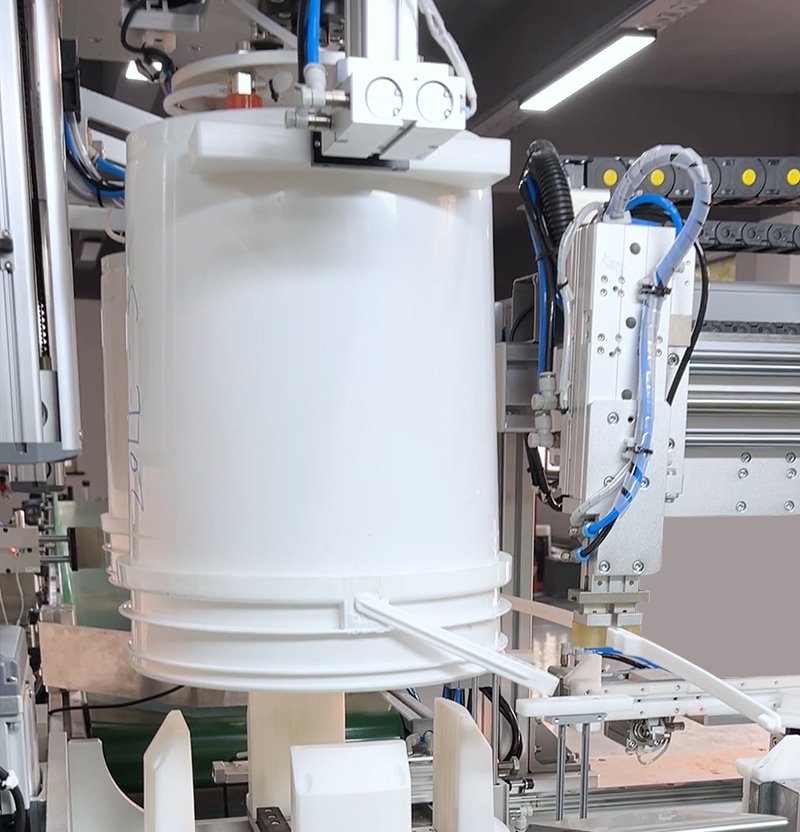
However, selecting the right equipment involves more than comparing machine prices or advertised production speeds. Manufacturers also need to consider bucket compatibility, installation quality, changeover time, floor space, production capacity, and integration with existing equipment.
In this guide, we explain the key factors to consider when choosing an automatic bucket handle assembly machine and how the right solution can support more efficient plastic bucket manufacturing.
1. What Is an Automatic Bucket Handle Assembly Machine?
An automatic bucket handle assembly machine is industrial equipment designed to install handles onto compatible plastic buckets with reduced manual intervention.
Depending on the machine configuration, the automated process may include:
- Automatic handle feeding
- Bucket positioning and alignment
- Automatic detection of handle mounting holes
- Controlled handle fitting
- Finished bucket discharge
- Integration with conveying or downstream automation equipment
Instead of requiring an operator to manually install every handle, the machine coordinates the installation process through an automated mechanism.
For plastic bucket manufacturers, this can help reduce repetitive labor, improve process consistency, and create opportunities to connect handle fitting with upstream and downstream production operations.
The most suitable configuration depends on bucket dimensions, handle design, required output, and the existing factory layout.
2. Check Bucket Size, Shape, and Handle Compatibility
The first step in choosing an automatic bucket handle installation machine is to confirm whether it can handle your actual products.
Plastic buckets vary in capacity, height, diameter, shape, wall structure, and handle mounting hole position. Round buckets and square buckets may require different positioning arrangements, while handle designs can differ in shape and dimensions.
Before requesting a quotation, prepare the following information:
- Bucket capacity and dimensions
- Round or square bucket design
- Bucket material and structural characteristics
- Handle material, shape, and dimensions
- Handle mounting hole positions
- Number of bucket specifications produced regularly
- Required production output
AOE Automation offers automatic bucket handle fitting solutions for compatible plastic bucket specifications ranging from 1L to 25L, depending on the selected model and configuration.
The PH1620 is designed for standard 16L–20L bucket applications. Other bucket sizes can be evaluated for corresponding standard models or customized solutions.
AOE’s product information states support for 99% of standard plastic handle types. Because handle geometry, mounting structures, and bucket designs vary, the compatibility of a specific application should always be confirmed using actual product samples or technical drawings.
Selection tip: Do not choose a machine based only on bucket capacity. Confirm the bucket dimensions, mounting hole positions, handle design, and required installation method.
3. Prioritize Accurate Positioning and Damage-Free Installation
Installation quality is one of the most important factors when evaluating a plastic bucket handle fitting machine.
If the bucket or handle is incorrectly positioned, the fitting mechanism may apply force at the wrong angle or location. Depending on the product structure, this can lead to deformation, cracked mounting areas, inconsistent installation, or rejected products.
A suitable automatic bucket handle assembly machine should coordinate positioning, hole detection, and the fitting mechanism to achieve reliable installation.
Automatic handle hole detection
AOE’s automatic handle fitting solution uses automatic detection of handle mounting holes to help identify the correct installation positions.
This reduces reliance on manual visual alignment and supports a more repeatable fitting process.
Servo-controlled installation
A servo-controlled mechanism helps manage the movement of the fitting mechanism during installation. When combined with suitable positioning and alignment, it supports controlled and consistent operation.
Patented damage-free fitting technology
AOE has developed patented damage-free installation technology designed to help protect compatible plastic bucket bodies during handle fitting.
The system combines positioning, flexible alignment, and controlled installation to help reduce unnecessary stress on the bucket body.
For manufacturers producing paint buckets, chemical containers, lubricant pails, and other plastic packaging products, protecting the bucket structure can be important for maintaining finished product quality.
Actual installation results depend on the bucket material, wall thickness, mounting structure, handle design, and machine configuration.
Before purchasing equipment, request a demonstration using your actual bucket and handle samples. This allows you to evaluate fitting quality, installation consistency, and compatibility under representative conditions.
4. Compare Production Speed and Daily Output
Production capacity is a key factor when choosing an automatic bucket handle assembly machine.
A machine’s cycle time affects its potential output, but actual production also depends on operating hours, product changeovers, loading and discharge arrangements, and the stability of the overall production process.
The upgraded AOE PH1620
AOE Automation’s upgraded PH1620 standard machine has a reference cycle time of approximately 10 seconds per bucket.
The upgraded machine operates at roughly twice the speed of the previous version, which had a cycle time of approximately 15 seconds per bucket.
Under suitable production conditions, daily output can exceed 10,000 buckets.
For manufacturers processing large quantities of plastic buckets, faster handle fitting can help increase production capacity and reduce the time required for this stage of manufacturing.
However, a 10 second cycle should not automatically be interpreted as a guaranteed production rate for every application. Actual output depends on the bucket specification, handle type, operating schedule, changeovers, and production conditions.
When comparing machines, ask suppliers to clarify:
- The cycle time for your specific bucket
- The conditions used during machine testing
- Expected output per operating shift
- The effect of product changeovers on output
- Whether loading, discharge, and conveying are included in the quoted cycle time
The goal is to select equipment that meets your actual production requirements, rather than relying on an advertised speed figure alone.
5. Look for Convenient Changeover Between Bucket Sizes
Many plastic bucket manufacturers produce several sizes and product variations. If changing specifications requires extensive manual adjustments or fixture replacement, the resulting downtime can reduce production flexibility.
AOE’s automatic bucket handle assembly solution uses a touchscreen recipe library to store production settings for supported bucket specifications.
Operators can select a saved recipe when switching between compatible products, helping simplify the changeover process.
Depending on the machine configuration, the system offers:
- Touchscreen operation
- Saved production recipes
- One-click selection of supported specifications
- Convenient changeover between compatible bucket sizes
- No clamp replacement required for supported changeovers
This approach can be useful for factories that handle multiple orders or frequently switch between bucket specifications.
However, one-click recipe selection does not mean every bucket can be processed without adjustment. Compatibility and changeover requirements should be confirmed for each product family before purchase.
Ask the equipment supplier to identify which bucket models can share the same machine configuration and whether any additional tooling or adjustments are required.
6. Consider Machine Footprint and Factory Space
Factory floor space is an important consideration when introducing new automation equipment.
A machine that requires a large installation area may be difficult to accommodate in an existing production workshop, particularly when additional conveying equipment, safety clearances, or downstream stations are needed.
AOE’s upgraded PH1620 has a more compact design, with a footprint approximately 50% smaller than the previous version.
This reduction can make the machine easier to evaluate for installation in factories with limited floor space and may provide greater flexibility when planning the surrounding production layout.
When assessing the actual installation area, remember to consider more than the machine’s external dimensions.
You should also account for:
- Bucket loading and discharge space
- Operator access and maintenance clearance
- Handle feeding arrangements
- Conveyor connections
- Electrical and pneumatic connections
- Safety access and equipment servicing
A compact machine can help make better use of available space, but the final layout should be assessed according to the factory’s specific requirements.
7. Evaluate Automatic Handle Feeding and Ease of Operation
An automatic handle fitting machine should do more than perform the final installation step. Handle feeding and machine operation also influence production stability.
AOE’s machine uses a hopper-type automatic handle feeding system to support the supply of handles to the fitting mechanism.
Automatic feeding helps reduce the need for operators to manually position each handle, supporting a more automated and coordinated installation process.
When evaluating equipment, consider whether the machine offers:
- Stable handle feeding
- Consistent bucket positioning
- Clear touchscreen operation
- Convenient selection of saved production recipes
- Straightforward routine cleaning and maintenance
- Accessible troubleshooting and technical support
The purpose of automation is not simply to increase machine speed. It is also to create a production process that operators can manage consistently and that maintenance personnel can support effectively.
8. Check Integration with Your Existing Production Line
An automatic bucket handle assembly machine can operate independently or be incorporated into a broader plastic bucket production automation system.
For manufacturers looking to reduce manual handling between processes, integrating compatible equipment may create a smoother production workflow.
Depending on the factory layout and selected configuration, a connected production process may include:
- Plastic bucket production by injection molding
- Bucket transfer and positioning
- Automatic handle feeding and fitting
- Finished bucket conveying
- Automatic sorting or stacking
- Robotic palletizing and downstream logistics
AOE Automation provides customized industrial automation solutions that can be evaluated for integration with compatible injection molding equipment, conveyors, robotic arms, and downstream handling systems.
Before planning integration, evaluate the injection molding machine configuration, bucket discharge method, production cycle, available space, electrical and control interfaces, and downstream equipment requirements.
Not every existing production line can be connected without modification. A technical assessment is needed to determine whether the equipment can be integrated directly or whether additional transfer, control, or handling arrangements are required.
For factories planning a wider automation upgrade, it is worth considering the complete workflow from handle installation to sorting, conveying, stacking, and robotic palletizing.
9. Calculate the Total Cost of Ownership
The purchase price is only one part of the cost of an automatic bucket handle assembly machine.
Manufacturers should consider the total cost of ownership and the expected operational benefits over the machine’s service life.
Important factors include:
- Initial equipment investment
- Installation and integration costs
- Labor currently required for manual handle installation
- Expected machine utilization
- Maintenance and spare parts
- Production downtime
- Product defects and rework
- Available factory space
- Future production expansion requirements
A faster machine may provide more production capacity, while a smaller footprint may offer greater flexibility in factory planning. However, the actual financial benefit depends on how the machine will be used in your production environment.
For a realistic investment assessment, calculate the current labor cost of handle installation and compare it with the expected operating costs and utilization of the automated solution.
Avoid relying on generic payback claims. A meaningful return-on-investment estimate should use your factory’s actual production data, labor costs, working hours, and operating requirements.
10. Choose an Automation Supplier with Relevant Engineering Experience
The right machine is only part of a successful automation project. Product testing, equipment configuration, installation planning, and technical support are also important.
AOE Automation specializes in customized automation equipment and intelligent production solutions for plastic bucket manufacturers.
Our approach starts with understanding the customer’s products, production targets, existing equipment, and factory layout.
Depending on the project, the process may include:
- Reviewing bucket and handle samples
- Evaluating compatibility and production requirements
- Selecting a suitable standard model or customized configuration
- Designing the required automation arrangement
- Manufacturing and testing the equipment
- Coordinating installation and commissioning
- Providing technical support after delivery
Before placing an order, confirm the scope of pre-shipment testing, installation responsibilities, operator training, maintenance requirements, and available support services.
A supplier that understands your actual production process can help you evaluate not only the machine itself, but also how it fits into your manufacturing operation.
AOE PH1620 Automatic Bucket Handle Assembly Machine: Technical Specifications
AOE’s upgraded PH1620 standard machine is designed for manufacturers seeking faster bucket handle fitting in a more compact machine footprint.
| Specification | PH1620 |
|---|---|
| Standard bucket range | 16L–20L |
| Other bucket sizes | customized solutions available |
| Bucket shapes | Round and square |
| Handle type | plastic handles |
| Reference cycle time | Approximately 10 seconds per bucket |
| Daily production capacity | Over 10,000 buckets under suitable operating conditions |
| Machine footprint(mm) | 2000*1000 |
| Installation success rate | 99.99% |
| Handle feeding | Hopper-type automatic feeding |
| Control system | Touchscreen with saved production recipes |
| Changeover | One-click recipe selection for supported specifications |
| Installation technology | Patented damage-free fitting technology |
| Rated power | 3.6 kW |
| Air consumption | 50 L/min |
| Discharge and integration | Configuration depends on production requirements |
| Customization | Available for applicable machine functions and product requirements |
The 10 second cycle time, daily production capacity, reduced footprint, and 99.99% installation success rate refer to AOE’s stated upgraded machine specifications. Actual performance depends on the bucket and handle combination, operating conditions, and machine configuration.
The installation success rate should be interpreted according to the applicable test conditions and measurement method. Confirm the latest technical documentation and application requirements with AOE Automation before final equipment selection.
Frequently Asked Questions
What does an automatic bucket handle assembly machine do?
An automatic bucket handle assembly machine automates the process of fitting handles onto compatible plastic buckets. Depending on its configuration, the system can coordinate automatic handle feeding, bucket positioning, mounting hole detection, and controlled installation.
How fast is AOE’s upgraded PH1620 machine?
The upgraded PH1620 standard machine has a reference cycle time of approximately 10 seconds per bucket. Actual output depends on product specifications, operating conditions, changeovers, and production arrangements.
Can the PH1620 produce more than 10,000 buckets per day?
AOE’s upgraded machine is designed to support daily output exceeding 10,000 buckets under suitable production conditions. Actual output should be evaluated according to the factory’s operating schedule, bucket specifications, and production process.
How much floor space does the upgraded machine save?
The upgraded PH1620 has a footprint approximately 50% smaller than the previous version. The installation area required for a complete system also depends on feeding, discharge, conveying, safety clearance, and maintenance access.
What is the installation success rate of the PH1620?
The stated installation success rate is 99.99%. Manufacturers should confirm the test conditions, sample size, and measurement method used for this figure, and evaluate performance with their own bucket and handle specifications.
Can one machine handle different bucket sizes?
A suitably configured machine can process multiple compatible bucket specifications. AOE’s touchscreen recipe library helps operators select saved settings for supported products. The compatible range and any required adjustments should be confirmed before purchase.
Does the machine help prevent bucket deformation?
AOE’s patented damage-free fitting technology combines automatic positioning, flexible alignment, and controlled installation to help reduce stress on compatible bucket bodies. Actual results should be evaluated through testing with the customer’s bucket and handle samples.
Can the machine connect to an existing injection molding line?
Integration can be evaluated for compatible injection molding equipment and existing production lines. Feasibility depends on the production cycle, discharge arrangement, factory layout, control interfaces, and downstream equipment.
How do I choose the right machine for my factory?
Prepare bucket dimensions, handle samples or drawings, required production output, the number of product specifications, and information about your existing production line. A supplier can use these details to evaluate compatibility and recommend a suitable machine configuration.
Discuss Your Bucket Handle Automation Project with AOE
Choosing the right automatic bucket handle assembly machine starts with understanding your products, production targets, and factory layout.
AOE Automation offers automatic bucket handle fitting solutions designed to help plastic bucket manufacturers automate repetitive installation, improve production workflow, and explore more integrated manufacturing processes.
With the upgraded PH1620 offering a reference cycle time of approximately 7–8 seconds per bucket, daily production capacity exceeding 10,000 buckets under suitable conditions, and a footprint approximately 50% smaller than the previous version, manufacturers can evaluate a solution designed to combine faster fitting with more efficient use of factory space.
Whether you need to automate manual handle installation, process multiple bucket specifications, or explore integration with your existing production line, our team can help assess your requirements.
Send us your bucket dimensions, handle samples, and production targets to discuss a suitable automation solution.
Website: https://aoe-automation.com/
AOE Automation — Let’s Build the Right Automation for Your Bucket Handle Fitting.